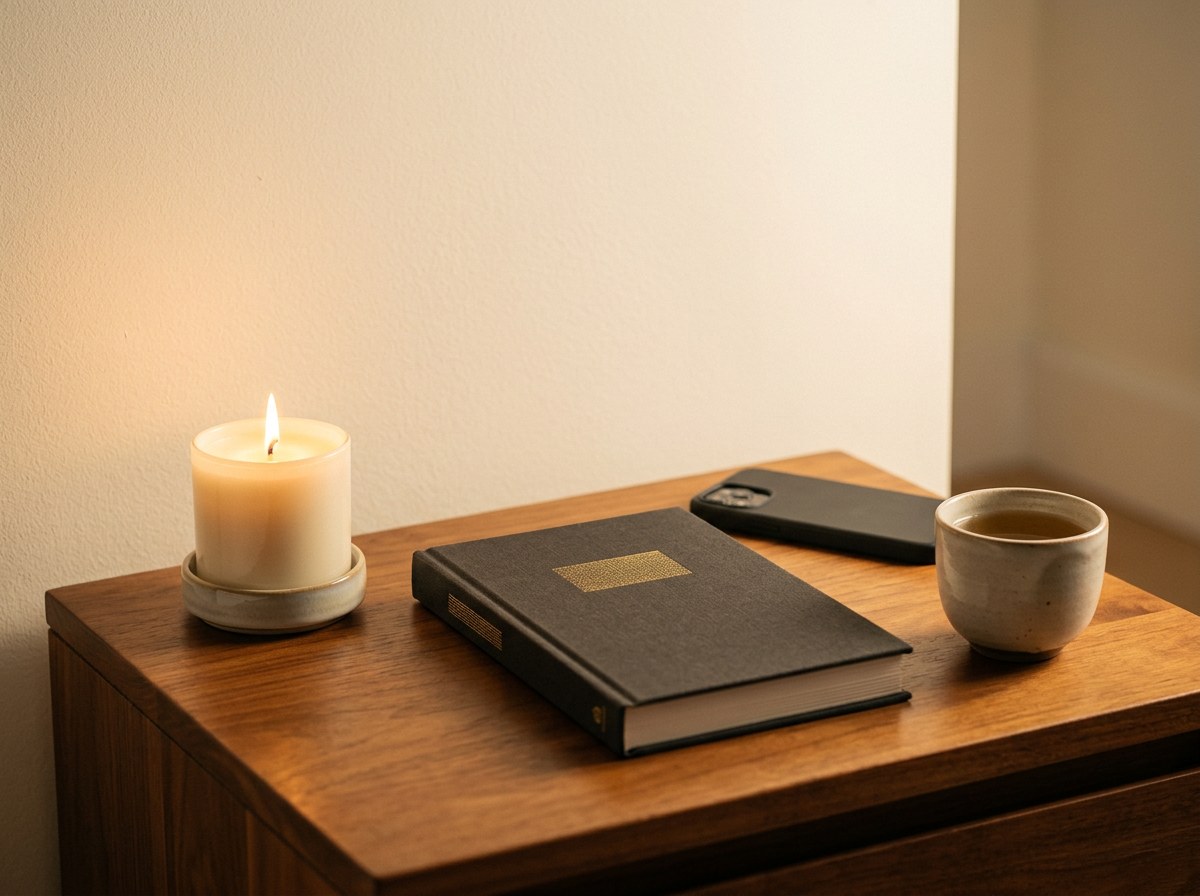
You finish a cup of tea and cannot remember drinking it. You drive somewhere familiar and barely notice the road. You sit with people you love and your mind is somewhere else entirely. Most of us live like this more than we would like — carried forward by the next task, the next worry, the next screen. Learning how to be more present is not a mystical skill. It is the simple, trainable habit of coming back to what is actually happening right now — the core of how to stay present without forcing anything. And if you would like a gentle sound to anchor you to the moment as you read, the track below is a calm place to begin.

What Being Present Actually Means
Being present is often misunderstood as emptying the mind of all thought. That is nearly impossible, and chasing it makes people feel like failures. Real presence is gentler: you notice that your attention has wandered, and you bring it back — to your breath, to the cup in your hands, to the voice in front of you. The coming back is the practice. You do it a hundred times a day, and each return is a small victory.
This matters because most suffering is not in the present moment. It lives in the past (replaying what happened) or the future (bracing for what might). When you step into present moment awareness, even briefly, the anxious storyline loses its grip — not because you solved it, but because you stopped living inside it.
Three Ways to Return to the Moment
You do not need an app or a silent retreat. You need small anchors you can reach for anywhere:
- The breath: feel one slow inhale and one slow exhale. That is all — one breath, fully noticed.
- The senses: name three things you can see, two you can hear, one you can feel. This is one of the simplest grounding techniques for anxiety.
- The ordinary act: wash a cup, open a door, or walk to the window and actually feel your feet on the floor as you go.
Pick one and use it a few times a day — especially at transitions, like when you arrive somewhere or when you reach for your phone. Presence is a muscle, and these small returns build it faster than an hour of trying to 'meditate' once a week. For anyone new to this, mindfulness for beginners need not mean a long sit — it begins with the very first ordinary moment of the day: the warmth of the shower, the taste of the first sip, the light through the window before the phone comes out.
When the Mind Will Not Stop
Some days the thoughts are too loud to sit with, and that is not a failure. This is where sound can help. A slow, wordless track gives restless attention a single calm place to land, so being present with yourself becomes easier than fighting the noise. If you want that kind of sound to carry you into the moment, the warm piano, violin and saxophone collection at our sister site — relaxing music for inner peace — was made exactly for this.
A Quieter Way to Live
You will not be present all the time — no one is. The goal is simply to return more often, and sooner, until presence becomes your default more than your exception. Start with one cup of tea, one breath, one door. The moment you are looking for is not somewhere else. It is right here, waiting for you to notice it.