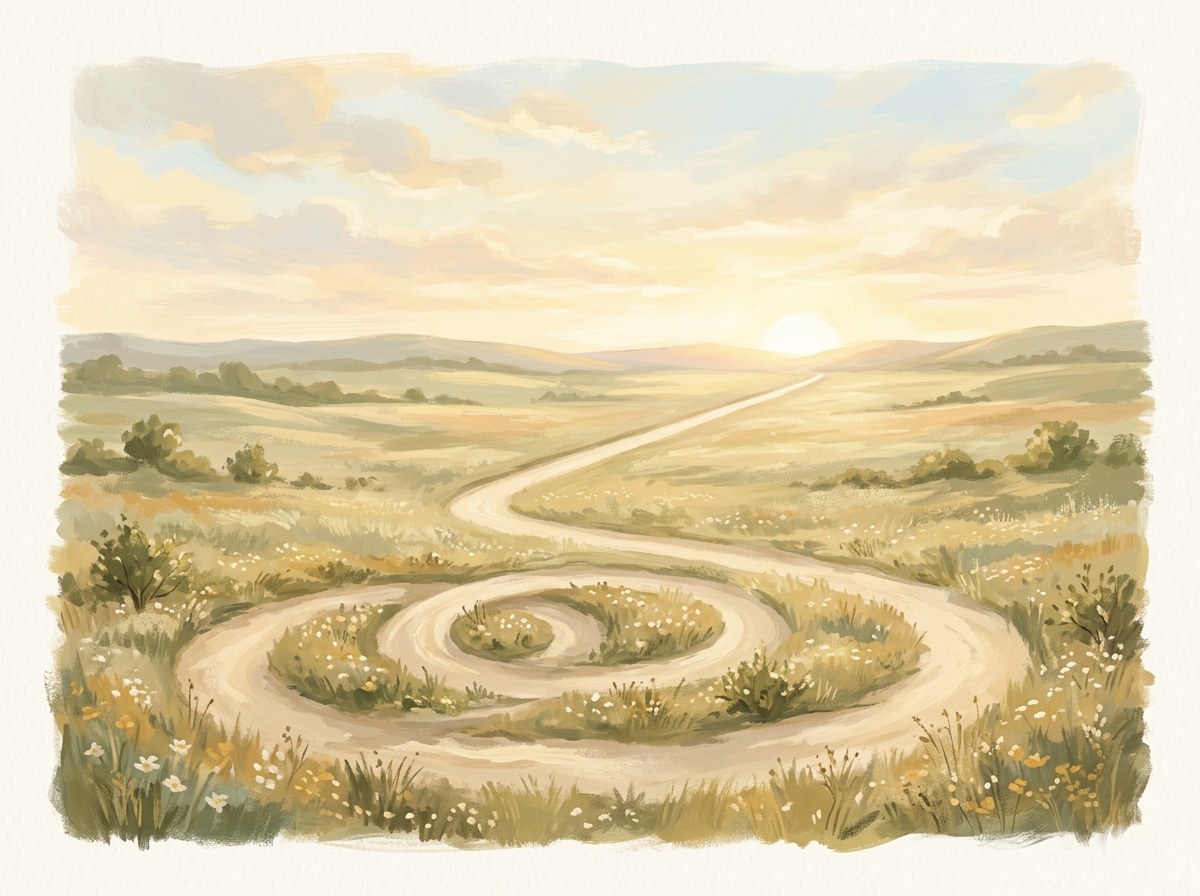
There is a particular torment in an anxious mind: the thought completes, relief approaches, and then the very same thought starts again, unchanged, as if running on rails. It is not laziness, and it is not weakness. Anxiety loops because the mind mistakes the repeating worry for a problem still unsolved, and so it keeps returning to check. Logic rarely ends the loop — you cannot argue with a mind that hears only itself. Sound, however, can interrupt it. Music to calm anxiety works on a level more basic than reasoning, matching the body's rhythm and quietly refusing to let the mind keep spinning.
Why the Mind Gets Stuck in the Loop
The anxious mind loops because uncertainty feels intolerable to it. Every repeat is the brain's attempt to resolve a question it believes is still unresolved, so it runs the tape again to look for an answer. Music for peace does not try to answer the question — it changes the question. By anchoring attention to a slow, unfolding sound, it gives the mind something steady and finite to follow instead of the infinite loop of worry. Calming music for anxiety hands the brain a task it can actually finish: listen, follow the arc of the melody, reach the end. A finished task is precisely what an anxious mind has been denied.
Why the Body, Not Just the Thoughts, Takes Part
Panic is not only in the mind; it is a whole-body event. The breath shortens, the heart rises, the shoulders climb toward the ears, and the body begins rehearsing for a threat that is not in the room. Anxiety relief music targets exactly this layer, because sound is physical and travels through the body before the mind has time to interpret it. A slow tempo invites the breath to slow down to keep pace — and as the breath slows, the body receives the calm nervous system music was promising: a signal that the emergency is over, even when the thoughts have not yet been told.
- The loop feeds on imagined futures; sound pulls the mind into an actual, present moment.
- Logic fights the loop on its own ground; music quietly changes the ground itself.
- Routine matters more than volume — the same calming music for anxiety, played the same way, teaches the body safety over time.
- Music for calming nerves is not about escaping; it is about returning to a room you forgot you were safe in.
What Angelic and Peaceful Music Offer That Other Tracks Don't
Not every relaxing track calms an anxious mind equally. Calm, spacious pieces with open chords and long, unbroken tones tend to work better than busy or dramatic music, because they give the nervous system room to soften rather than something new to track. Angelic music and peaceful christian music share this quality without belonging to any one tradition: a wide, warm sound with no abrupt shocks reads to the body as sanctuary. Music for anxiety relief that keeps a steady, generous pulse is the most reliable for breaking a loop, because it gives the repeating mind a slower, wider pattern to slip into.
A Pocket Practice for the Middle of a Spiral
You cannot always run to a piano or a playlist in the middle of a spiral, but you can carry a small version of it. When you notice the loop starting, do three things. First, name it out loud if you can: ‘this is the loop again’ — naming interrupts the spell. Second, slow your exhale until it is longer than your inhale; duration matters more than depth. Third, put on one slow track and follow only the sound, letting peaceful music be the rails your attention travels instead of the worry. Within a few minutes the tight, urgent circle opens — not into forced calm, but into something closer to ordinary air.
Making Calm a Habit Before the Storm
The most effective way to use music to calm the mind is to practise it when you are not anxious. A daily ten-minute ritual with music for peace builds a kind of mental terrain the loop cannot easily cross — a familiar resting place your body already knows. When panic does arrive, you are not improvising a survival tactic in the middle of the storm; you are returning to ground you have visited before. Relaxing anxiety music rehearsed on calm days becomes a trained response on hard ones. The goal is not to never loop again, but to shorten the loop — and sound, practised ahead, is one of the kindest ways to do that.